Fundamentals of Printmaking#
Before continuing we will be covering some of the common terminology and fundamental concepts associated with printmaking. Terminology differs across the various methods and some terms are also method specific. This guide is divided into sections for each method starting with fundamental concepts that are unique to that form of printmaking. Here we will be covering the universal concepts that carry across all formats.
Key terminologies#
Impression#
Printmaking is the act of taking impressions from one surface on to another. There are a number of ways in which this is possible and the simplest form of ’taking an impression’ can be understood through stamping. A stamp is the most basic form of a printing, one side is the source of the print (the stamp) the other the print itself (the paper or surface) which is ‘an impression’ of the source. This is the basic understanding for all forms of printmaking and each method is a play on how an impression can be taken from a surface. Whenever asked about how you intend to ’take an impression’ it is very concept that is being referred to.
Surface#
The surface in printmaking refers to where the impression is being taken. This is usually paper but can also be fabric, wood, or any other surface as well; even a wall.
Matrix#
As part of taking an impression you require a source for that impression. In printmaking that source is referred to as the ‘matrix’.1 A matrix can be made of various materials depending on the form of printmaking being practised. For instance, in relief printing the matrix can be a block of wood and in intaglio printing the matrix can be a metal plate. The process of preparing the matrix is often also referred to as platemaking and often takes up most of the time when printmaking.
While different methods may have different kinds of matrices, you are by no means restricted to having the same matrix across a print. It is perfectly normal and common practice to have different kinds of matrices used to build a print.
Thinking in reverse: Printmakers need to think in reverse (most of the time) when preparing a matrix. This is because often times the matrix will be facing upwards while the paper or surface to be printed on will be placed on top of the matrix. For example, if you have text written the right way on the matrix, it will be printed in reverse on the paper.
Pulling#
The process of lifting the print from the matrix or once the impression has been taken, is referred to as ‘pulling a print’. Depending on the form of printmaking the reasoning may differ but the intention remains the same:
- Relief, Intaglio, & Lithography: The press is turned in a pulling motion and the paper is pulled off of the surface of the matrix.
- Serigraphy: Ink is pushed through the screen by ‘pulling’ the squeegee towards yourself, the paper is then pulled away from the surface.
Pressure#
Printing of any kind requires applying pressure on to the matrix. This pressure ensures the impression is transferred onto the paper, fabric, or other surface. Normally this pressure refers to a press but can also refer to pressure being applied by hand such as with a baren or wooden spoon.
A baren comes from Eastern traditions of printmaking (specifically Japanese) and is traditionally made of a pad of twisted cord wrapped with paper, cloth, and bamboo leaves. Modern equivalents of a baren are made of wood, metal, ball bearings, and handle. The intention remains the same of applying consistent and controlled pressure by hand.
Reproducibility#
Reproduction is at the heart of printmaking and it is what differentiates this medium from other forms of art such as sculpture, ceramics, painting, etc. While you may be able to also reproduce your work in different art forms, the level of reproduction that is possible in printmaking is unique. Reproducibility refers to the ability to make copies of your work as printmaking is both art and craft. There is a strong monetary association with the printed medium hence the reason for reproducibility to be such a big factor in determining the quality of a print as well as a printmaker. Reproduction of a print results in editions which are a concept unique to printmaking. An edition refers to a print that is a 1:1 perfect replica within a series of prints and includes replicating printing quality, surface material, pressure, and ink application across all prints within that series.
It is important to point out that reproducibility should not be a hinderance to your own artistic practice. You have no need to produce copies of your work or create editions. There are methods that utilise printmaking in a painterly manner to create one-off prints as well.
Registration#
Printmaker’s go into the printing process blind. What that means is that you are never sure of what is on the matrix till you have taken a print. For this reason printmaking is often seen as a very controlled medium as well as many different methods and approaches have been devised to maintain reproducibility and return control to the artist. Registration refers to one such manner of returning control to the artist by approximating the positioning of a matrix and the print. This is normally the first step before printing can commence and can be as simple as drawing a guide on a piece of paper or as complex as a jigsaw system to ensure the matrix is always in the correct place for printing.
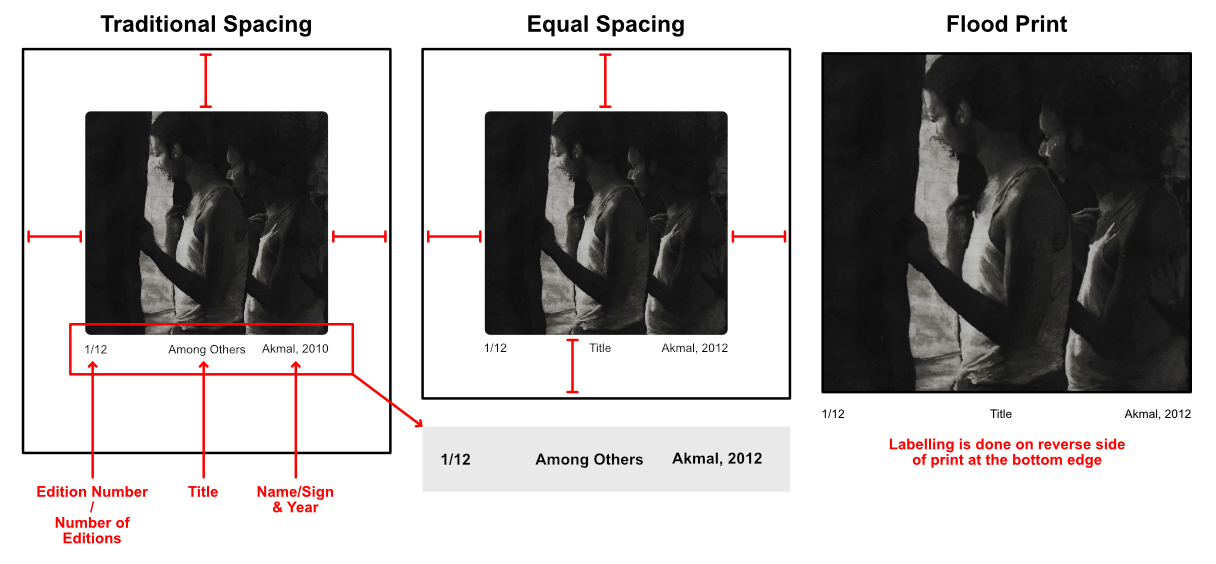
Simply put a registration is a guide for aligning the print correctly. There are different ways to register a print and the traditional method is to maintain a 3:1 ratio on the surface especially if it is paper. This ratio refers to keeping the top, left, and right edges of the paper equidistant from the printed area, and the bottom edge farther away to accommodate labelling. Centralised registrations are also common.
While a guide on a sheet of paper is often enough, when dealing with complex prints with multiple colours and plates a more complicated registration is required. Jigs are a common way to do this as is the pin and tab method. The pin and tab method involves having a stable point on the press (the tab) and a physical pin that can fit into the tab that is secured to the paper. This is a more complicated method and normally requires using Ternes-Burton or similar registration pins.
Proofing#
The early stages of printing is often referred to as proofing. Several prints may be taken at this stage to ensure the matrix is ready for final printing. When instructed to ‘proof a print’ it means to take a print in order to judge the state of the matrix. As mentioned, printmakers are blind to the process until a print is taken which is why proofing is done over several stages or the platemaking process.
Labelling#
Traditionally prints are labelled to differentiate them from other forms of art. The labelling process varies in how the print was constructed but traditionally is done just outside the bottom edge of the printed area and in pencil. In the case of a flood print (a print that covers the entire paper) labelling is done on the reverse while some artists may prefer to do it on the front on top of the image as well (not common practice). Labelling consists of four components: Notation, Title, Artist, and Year. The table below and graphic give an example of what component of a label is and how it should be presented.
| What | Where | How |
|---|---|---|
| Notation | Bottom-left edge | It should represent either the number of edition or type of print (see list below for more) |
| Title | Middle edge | The title of your work if there is one |
| Artist | Bottom-right edge | Name of artist or signature |
| Year | Bottom-right edge | Year of production, often after the artist signature |
There are different kinds of prints that come out of the printmaking studio and it is important to be able to distinguish them correctly with proper notation. This is partly because you don’t want to accidentally work on a print that is part of an edition and also because the labelling can incur more value to the print as well. For instance, typically editions are valuable because they are limited in number while artist proofs are less valuable as they are one-off prints. The table below shows the different types of notations done on a print, how they are represented, and what they mean.
| Type | Notation | Represents |
|---|---|---|
| Edition | n/N (e.g. 1/10) | Editions are limited number of prints and are shown as the number of print out of a series of prints, so 1/10 is the first print out of 10 identical prints. |
| Artist’s Proof | A/P | An artist’s proof is often a print taken out of a series or editions that the artist has further worked on to create a print that is different from the series. They are normally also prints kept by the artist and often make up 10% of all editions in a series. |
| Printmaker’s Proof | P/P | Often times in a printmaking studio the master printmaker works with an artist to prepare the image. In these cases when the artist is not the printmaker themselves, the printmaker keeps selective prints for themselves. Normally only 1 print in a series is marked like this. |
| Ready to Print | R.T.P. | When preparing an edition the first print that is labelled as R.T.P is considered the benchmark for all editions to ensure they are of the correct quality. |
| Trial Proof | T/P | These are unfinished prints made as drafts, often they are abbreviated to proofs or proofing. |
| State Proof | S/P | Often the artist may make modifications to a print, these change the state of the image and are labelled accordingly to avoid confusion. |
| Cancellation Print | C/P | Many times the artist or printmaker may deface or destroy the original matrix to ensure no more editions of the artwork are possible. Any printing done after this has happened are considered cancelled prints. |
| Variable Edition, Unique Print, or Unique State | V/E, U/P, or U/S | These labels all mean the same thing, they are one-off prints and unique. These prints cannot be reproduced due to distinguishing features. |
| Monotype or Monoprint | M.T. or M.P. | Similar to the above it signifies a single print made using a monotype format. |
| Hand Modified Print | H.M.P. | A common feature of printmaking is to create unique prints by modifying them post printing by drawing on them. |
| Edition Varied | E.V. | When different editions of an image are printed on different ink colour or paper these are called varied editions. |
| Hors Commerce | H/C | French for ‘out of trade’ these are prints that are not for sale. |
| Impressit | Imp. | This label is used by artist who print their own work instead of printing through a printmaking studio or master printmaker and is put after the artist’s signature. |
-
Not to be confused with The Matrix ↩︎