Fundamentals of Intaglio#
Intaglio comes from the Western tradition of printmaking with the invention of the printing press. A matrix normally made of a metal alloy is used as the surface for image making. The word ‘intaglio’ finds its roots in intagliare which is Italian for ’to carve’ or ’to cut into’ meaning the matrix (commonly referred to as the plate) is carved into using a variety of methods. All forms of intaglio printmaking involve creating grooves or depressions on the surface of a plate in order to allow ink to gather within them this means ink rests underneath the surface and an immense amount of pressure is needed for pushing it out onto paper. In the image below you can see how intaglio printmaking differs against other forms of the medium.
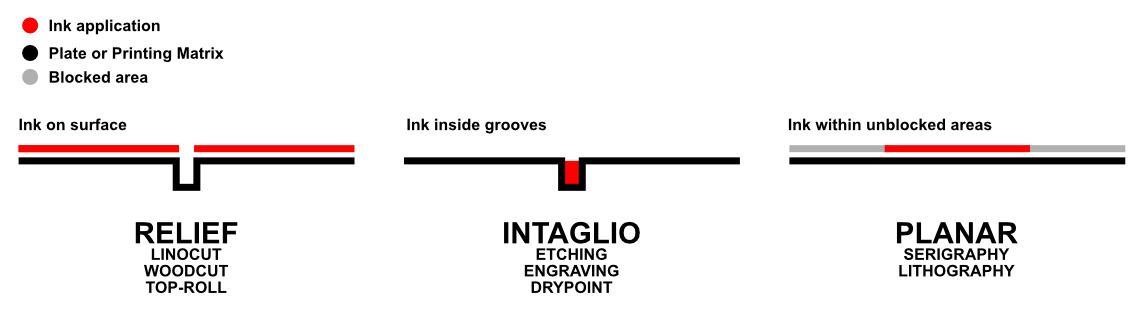
While it’s origins lie in Western traditions of printmaking, intaglio has formed one of the three fundamental types of printmaking that are practiced globally. A point should be made that just because intaglio printing means ink is added within the grooves does not mean you cannot add ink to the surface the way you would for a relief. The term intaglio simply refers to when a print has a groove where ink can collect. You can use intaglio methods explored in this guide to create a plate and then take a top-roll of ink the same way you would for relief. Adeel uz Zafar’s prints use this printing approach for presenting intricate details achieved through intaglio etching methods.
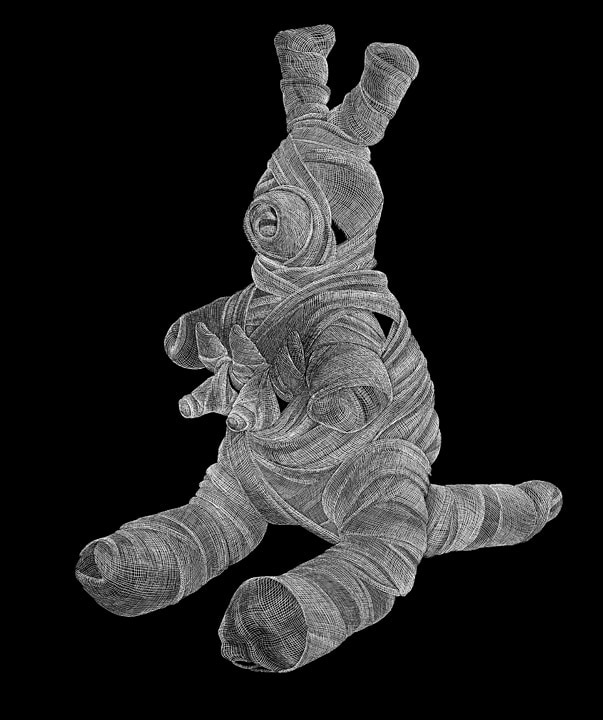
Adeel uz Zafar, Flyer with Conjoined Joyes (Drawing Appendeges Series), 2013, Etching
Key Terminology#
- Plate: In intaglio printing the plate is the matrix on which the image is prepared. This is normally made of metal but in some cases can also be an acetone sheet (see Drypoint).
- Mordant: A corrosive liquid normally an acid used to corrode away at a metal plate.
- Bite: The ability of a mordant to corrode a plate, such as when saying “the acid bites the plate” meaning the acid is corroding the plate.
- False-bite: An incorrect or unplanned manner of biting that is often avoided.
- Etch: Short for etching, refers to when the acid has bitten the plate to leave intaglio grooves.
- Wiping: The act of removing surface ink from a plate so ink is only present in the grooves of an intaglio plate.
- Degreasing: The process of removing grease and oil residue from the surface of a plate.
Fundamentals#
There are two main approaches towards intaglio and while fundamentally the same—both create grooves in the surface of a plate—the end results vary drastically between the many techniques under them. Intaglio printing can be done either using a mordant (acid) or without one (non-acid based). A mordant is simply anything that has corrosive properties and since most intaglio printing is done on a metal plate, this mordant is typically a metal reactive acid. What is important is that the mordant used is compatible with the plate as not every acid will etch a particular kind of plate.
Safety#
It is important to take on all required safety procedures before proceeding with acid-based intaglio printing. Please ensure you understand the requirements of your studio as well as the dangers involved with any kind of acid-based printing method.
Before beginning to work on any intaglio processes you should familiarise yourself with the safety precautions needed for working in an intaglio studio. Wear gloves to protect
Studio setups. Handling acid of any kind is dangerous but not an uncommon element in a printmakers studio. This is where art meets science specifically chemistry and it is important to understand the chemistry involved in the process you are attempting to recreate in your studio. Different kinds of mordants react in different ways as well, for instance copper is a common metal used for etchings and can only be etched with ferric chloride. The chemistry of ferric chloride as a mordant for copper results in a residue forming on the surface of the plate as the acid bites. This residue needs to be removed to avoid a false-bite. For this reason copper plates are dipped in a vertical bath of ferric chloride so the residue can float to the surface. Other methods such as nitric acid on zinc plates form bubbles as the acid bites which need to be gently brushed away with a feather.
Platemaking#
Platemaking will differ depending on the kinds of methods used to create the image. If using an acid-based method then it is necessary to understand the chemistry of the acid and the plate.